Victory Fellowship Bible Study
273 23rd St. S.W., Barberton, OH 44203
Wednesdays at 7pm
Rev. Roderick D. Grabski (330) 858-0223
WEBPAGE: victoryfellowshipministries.com
arod4God@neo.rr.com FACEBOOK: Roderick Grabski
Session THIRTEEN: PAUL’S 2ND MISSIONARY JOURNEY - Part 2
I. ANNOUNCEMENTS and PRAYER CONCERNS
II. Read / Listen / Discuss ACTS 17:1-34
a. Discuss initial observations & translation differences
• Chapter 17 vv. 3-4, 9, 16, 22, 26
III. The Journey Continues
a. Review maps and Paul’s Journey page.
b. Wounded from the beating in Philippi, they make a 100 mile trek to Thessalonica, along the Via Egnatia (17:1-9):
• Capital of Macedonia, population about 200,000
• See 1st Thessalonians 1:6-9 (written from Corinth in 51 A.D.)
• Remember Paul’s pattern
1. Here, for 3 weeks he “reasoned from the Scriptures,” he “proclaimed Jesus,” and he “identified the historic Jesus as the Messiah (Christ) of Scripture.”
• Jews, God-fearing Greeks, and many prominent women converted
• Trouble-makers called in, not because of theological differences, but because of Jealousy.
• Jason appears before the authorities to hear Paul accused of high treason
1. Jason assures them Christianity is not an anti-Caesar movement
2. He posts a bond promising to have Paul and Silas leave town
c. By Cover of Night, Paul and Silas are led out of Thessalonica to undertake a 50 mile trek to Berea (vv. 10-14):
• Same pattern – only to more noble-minded folk
• More trouble from the Jews
• Paul sent 300 miles away to Athens. Silas and Timothy remain.
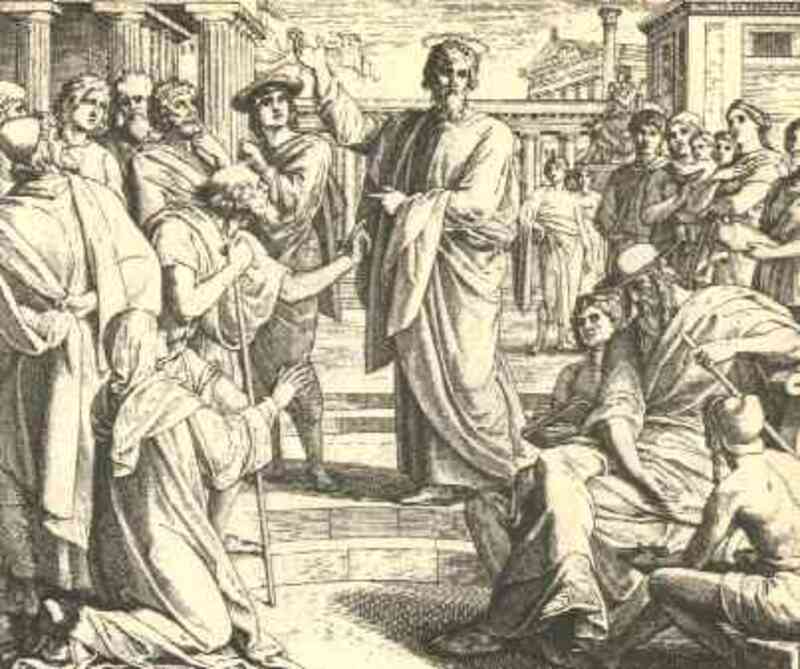
d. Paul finds a Preaching Platform in Athens (vv. 16-34):
• See map. A city with more idols than people riles Paul’s “righteous indignation.”
• Paul went, not only to the synagogue, but to the marketplace and streets.
1. Areopagus = Hill of Ares (Greek god of War) Roman name for this god was “Mars.” Hence “Mars Hill”
• Paul encounters “intellectuals.”
1. Epicureans (by Epicurus who died in 270 BC)
a. “philosophers of the garden”
b. Deists who didn’t believe in life after death.
c. Believe that Happiness achieved by serene detachment.
d. Eat, drink, and be merry for everything happens by chance.
2. Stoics (by Zeno who died in 265 BC)
a. “philosophers of the porch”
b. Inherent “world soul” has no emotional involvement. Align ones will with the universe. Pantheistic.
• Called Paul a spermologos – spermologos (literally, “seed-picker”) One who never had an original idea but “picked” from others.
• Paul points out the altar to an unknown god
1. He preaches systematic theology (vv. 24-31)
2. He quotes Greek poets Epimenides and Aratus (vs 28)
3. He lost most of them at “resurrection of the dead.”
IV. Read / Listen / Discuss ACTS 18:1-22
a. Discuss initial observations & translation differences
• Chapter 18 vv. 3, 21
V. Paul continues his Journey on to Corinth (18:1-18a)
a. Review “City of Corinth”
b. See 1st Corinthians 2:1-5 - “Korinthiazomai”
• He meets Pricilla and Aquila (same trade)
1. Edict of Claudius – around 49-50 A.D. "Since the Jews were constantly causing disturbances at the instigation of Chrestus, he [Claudius] expelled them from Rome" (Suetonius, Lives of the Caesars, Claudius 5.25.4).
c. Remember the pattern
• Silas and Timothy arrive bearing gifts
1. See 2nd Corinthians 11:8-9 and Philippians 4:14-16
2. Paul can now preach full time instead of making tents
d. Jews resist – Paul goes to the Gentiles
1. To Titius Justus’ home right next to the synagogue
2. But not without Crispus and his household
e. A Vision Word of Comfort from the Lord (vv. 9-10)
1. Corinth “Hall of Faith” also includes Phoebe, Tertius, Erastus, Quartus, Chloe, Gaius, Stephanus and his household, Fortunatus, Achaicus, and Sosthenes. All of these persons Paul mentions by name in his letters to the Romans and/or Corinthians.
• Paul stays a year and a half in Corinth (till around 52 A.D.)
• Paul is brought before the bema and the proconsul, Gallio
1. No time for religious stuff. Sosthenes takes a beating. (1Cor 1:1)
f. The Last Leg of the Journey (vv. 18b-22):
• Paul leaves Corinth with Pricilla and Aquila
• Aquila? Or Paul takes a Nazirite vow. (see Numbers 6:1-8,13,18)
• Short stay in Ephesus for Paul. Remember the pattern.
• A Promise to Return (vv. 20-21)
• Back at home
VI. APPLICATION
• We justify the need for world evangelism by 1) The Great Commission, 2) Compassion for those who do not know Christ, and 3) Zeal, even Jealousy, for the Glory of Jesus Christ to prevail over the gods of this age.
• Don’t be swayed by secular arguments and philosophies. Like the Bereans, examine the Scriptures for the truth.
VII. Close in Prayer
No Class Next Week – Holy Week
NEXT SESSION: PAUL’S 3RD MISSIONARY JOURNEY BEGINS
Read ACTS 18:23 – 19:41 to prepare for class.